Archive note
How to Calculate Triangle Perimeter
A repeatable method for homework, tests, and quick field checks when you need the distance around a triangle.
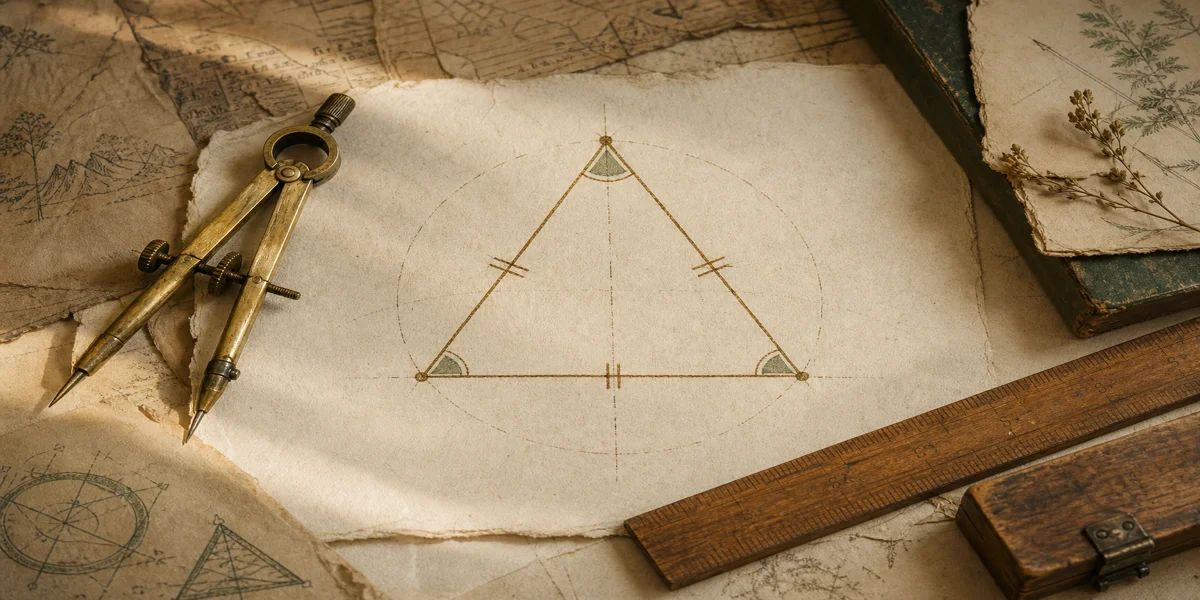

Archive note
A repeatable method for homework, tests, and quick field checks when you need the distance around a triangle.
Add all three side lengths in one unit after confirming the sides form a valid triangle.
Formula
Start on the home calculator if your diagram is already labeled and you want instant verification after you work by hand.
Calculation is reliable when you follow the same steps every time: sketch, measure, add, unit check, validity check.
Keep the symbol summary in the perimeter of a triangle formula article open if you switch between scalene, isosceles, and equilateral diagrams during one assignment.
You are summing boundary lengths. The answer describes how far around the triangle, not how much space it covers.
Teachers often mix perimeter and area on the same quiz, so read the prompt twice before you write any formula.
Construction and surveying versions of the same task still reduce to three sides, one unit, and one addition step when all edges are known.
When a side is unknown, find it with the method that matches your given information, then add all three sides.
Equal-side triangles allow P = 2a + b or P = 3a before you return to the general sum for a final check.
Story questions that describe fencing, borders, or trim usually want this sum even when they never use the word perimeter, which is why triangle perimeter word problems is a helpful follow-up once your calculation steps are solid.
Use this checklist on every problem, whether the numbers come from a diagram or a word story.
Sides 8 cm, 8 cm, and 5 cm describe an isosceles triangle. Perimeter is 8 + 8 + 5 = 21 cm.
Sides 6, 7, and 10 are scalene. Check inequality: 10 < 6 + 7, so the triangle is valid and P = 23.
Enter 8, 8, and 5 in the home calculator under 3 sides to confirm the isosceles total in seconds.
Consistent steps prevent unit errors, missing sides, and invalid triangles on tests.
Build fluency with worked perimeter examples across triangle types.
Solve triangle perimeter word problems: cue words, sketching tips, fencing and border examples, and how to check answers with a free online calculator.
Perimeter vs area of a triangle: formulas, units, cue words, real uses, and common mistakes so you pick the right measurement every time.
Scalene triangle perimeter with unequal sides: P = a + b + c, triangle inequality checks, geometry examples, and practice for tests and projects.