Archive note
Scalene Triangle Perimeter (P = a + b + c)
No equal sides means you always add three distinct lengths after you confirm the triangle is possible.
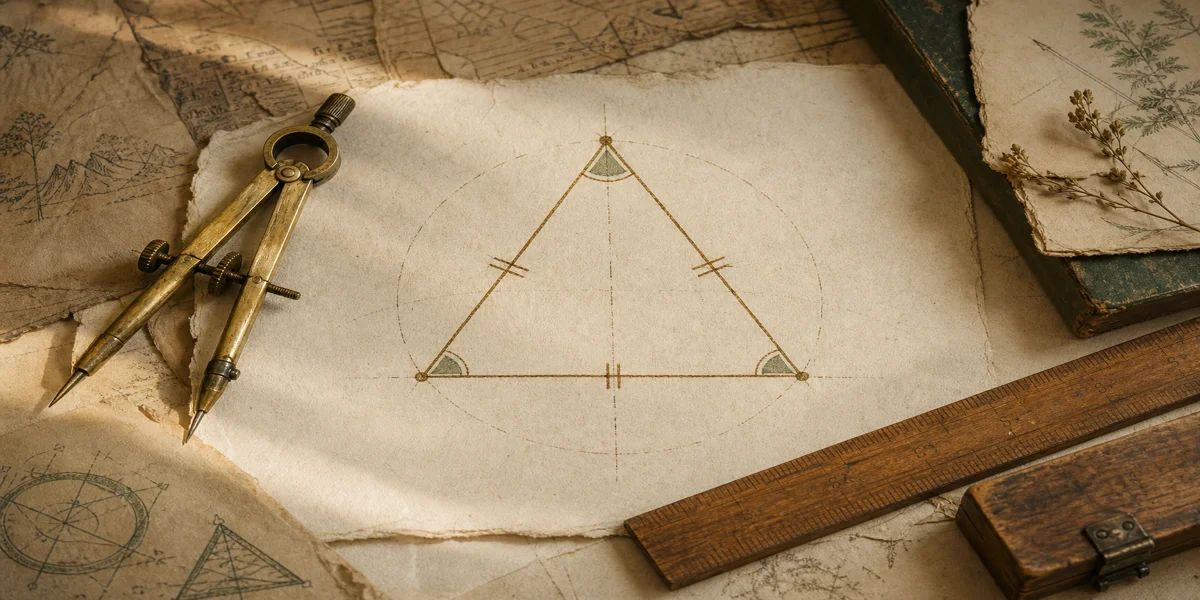

Archive note
No equal sides means you always add three distinct lengths after you confirm the triangle is possible.
P = a + b + c with all three sides different.
Formula
Enter all three sides on the home calculator for instant checks after you add by hand.
Scalene is the general case behind every shortcut for equilateral and isosceles triangles.
The core rule is P = a + b + c, explained with symbols in the perimeter formula guide.
Each side has its own length. No multiplication shortcut applies until symmetry appears on a different diagram.
Practical uses include irregular corners on land plots, custom frames, and triangles drawn from survey coordinates where no two edges match.
Educational exercises use scalene triangles to test whether students add all three sides instead of doubling one value by habit.
Angle types can vary. Scalene only describes sides, so the triangle may be acute, right, or obtuse while perimeter work stays the same.
Validate sides with triangle inequality before you add. The longest side must be shorter than the sum of the other two.
Example: sides 6, 7, and 10 are valid because 10 < 6 + 7. Perimeter is 23.
Invalid triples such as 3, 4, and 8 cannot form a triangle, so perimeter is undefined until measurements change.
A clear measuring routine appears in how to calculate the perimeter of a triangle, which applies directly to scalene diagrams.
Measure, validate, add, label.
Sides 6, 7, and 10 → P = 23.
Sides 4.2 cm, 5.1 cm, and 6.0 cm → P = 15.3 cm after you add decimals carefully.
A scalene garden corner with sides 11 ft, 13 ft, and 17 ft needs P = 41 ft of border material.
Scalene perimeter is straightforward addition after a validity check.
Practice with more examples and compare boundary length with area only when the prompt asks, as explained in perimeter vs area.
Solve triangle perimeter word problems: cue words, sketching tips, fencing and border examples, and how to check answers with a free online calculator.
Perimeter vs area of a triangle: formulas, units, cue words, real uses, and common mistakes so you pick the right measurement every time.
Isosceles triangle perimeter using P = 2a + b: equal-side properties, labeled diagrams, measurement examples, and common homework setups explained.