Archive note
Perimeter of a Triangle Formula
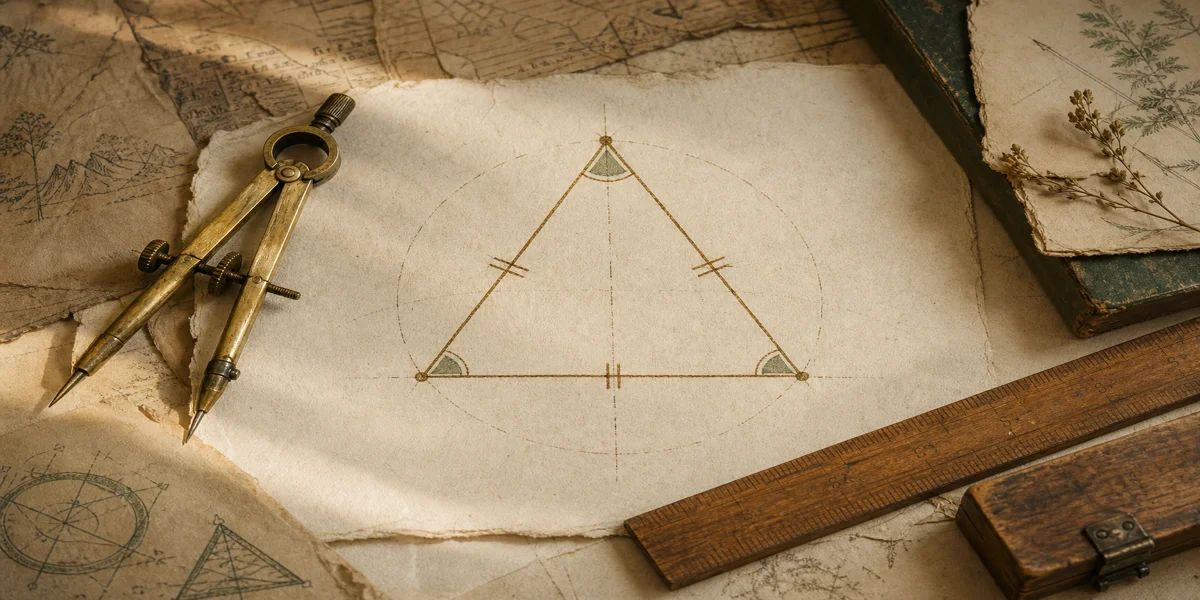
The perimeter formula adds side lengths. This article explains the basic rule, special cases, and how to read symbols on a diagram.

Archive note
The perimeter formula adds side lengths. This article explains the basic rule, special cases, and how to read symbols on a diagram.
P = a + b + c for any triangle with sides a, b, and c.
Formula
The Perimeter of a Triangle Calculator applies P = a + b + c and related rules from the measurements you enter.
Formula explanation starts with one idea: perimeter is the sum of outer edges. Everything else is a shortcut when sides repeat or when you must find a missing side before you add.
If you need vocabulary first, read what is the perimeter of a triangle. This page assumes you already know that perimeter means distance around the boundary.
Each letter stands for a side length in your chosen unit. The plus signs mean you travel each full side once, not half a side or a diagonal through the interior.
Geometric interpretation: three line segments meet at three vertices. Perimeter is the total length of those segments placed end to end around the outline.
Measurement concepts matter on site. Tape readings, scale drawings, and textbook diagrams all need consistent units before substitution.
Side-length addition is the core skill. Even when a problem later introduces angles, the final perimeter step still adds three sides after you know all three lengths.
Scalene triangles have no equal sides, so you always add three different values. That is the general case every shortcut builds on.
Isosceles triangles repeat one side length twice. Label the matching sides a and the remaining side b so P = 2a + b matches your sketch.
Equilateral triangles repeat the same side three times, which becomes multiplication: P = 3a.
After you choose the correct form, walk through numeric practice in our perimeter of a triangle examples article so the rules feel automatic under test conditions.
Treat every problem as label, substitute, add, then verify.
Scalene sides 7, 9, and 11 give P = 27 in the same unit.
Isosceles with equal sides 8 and base 5 gives P = 8 + 8 + 5 = 21.
Equilateral side 5 gives P = 3(5) = 15.
These three cases show how one core formula branches into faster paths when symmetry appears on the diagram.
Memorize P = a + b + c first, then add equilateral and isosceles shortcuts for speed.
When you are ready for a full procedure from sketch to answer, follow how to calculate the perimeter of a triangle step by step.
Solve triangle perimeter word problems: cue words, sketching tips, fencing and border examples, and how to check answers with a free online calculator.
Perimeter vs area of a triangle: formulas, units, cue words, real uses, and common mistakes so you pick the right measurement every time.
Scalene triangle perimeter with unequal sides: P = a + b + c, triangle inequality checks, geometry examples, and practice for tests and projects.