Archive note
What Is the Perimeter of a Triangle?
Perimeter is the distance around a triangle. This guide defines the idea, explains units, and shows where the measurement is used in school, construction, and surveying.
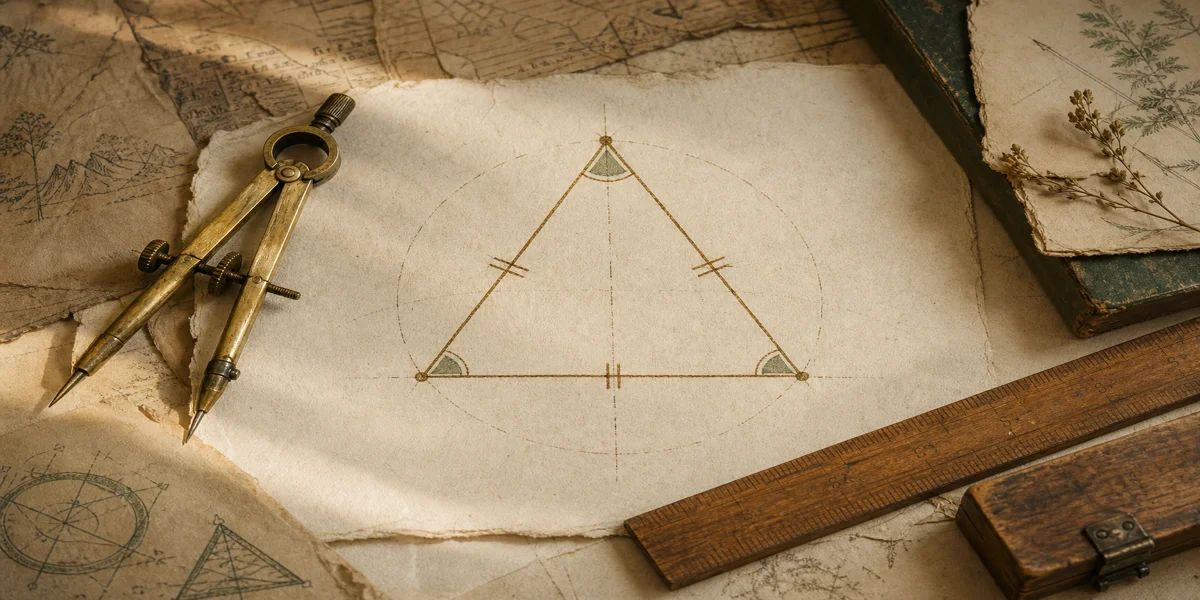

Archive note
Perimeter is the distance around a triangle. This guide defines the idea, explains units, and shows where the measurement is used in school, construction, and surveying.
Perimeter of a triangle is the sum of its three side lengths, written in linear units such as m, ft, or cm.
Formula
Use the Perimeter of a Triangle Calculator on our home page when you already know side lengths or angles and want a fast boundary total.
A triangle has three sides and three vertices. Perimeter answers one question: how long is the complete outer path if you trace every edge once?
Students often meet perimeter before area because the idea only requires addition when all three sides are labeled. Crews use the same idea when they quote rail length along a triangular lot edge or size trim for a three-sided frame.
This article stays focused on perimeter only. When you need symbols and special cases such as equilateral or isosceles shortcuts, continue with the perimeter of a triangle formula guide.
Perimeter is total boundary length. Walk along side a, then b, then c without cutting across the middle. Add those distances and you have the perimeter.
The meaning is practical: fencing a triangular garden, framing a warning sign, or checking a survey sketch all ask how far you travel around the outline, not how much ground the triangle covers inside.
Units of measurement must stay linear. If each side is measured in meters, perimeter is reported in meters. Square units belong to area, which is why confusing cm with cm² is one of the most common grading errors on tests.
Real-world applications include property corners on maps, custom metal frames, running tracks built from straight segments, and every geometry worksheet that asks for the distance around a triangle.
Perimeter is not semi-perimeter. Semi-perimeter is half of P and appears mainly in area formulas. For edging and border questions, you want the full sum around the shape.
The basic rule adds three side lengths. Letters a, b, and c should match the sides on your diagram so you do not swap a base with a leg by mistake.
Special triangles simplify the sum when sides repeat, but the idea never changes: every outer edge counts exactly once.
If you already know perimeter and are wondering whether the question is really asking for space inside the triangle, read perimeter vs area of a triangle before you pick a formula.
Before you calculate, confirm what the question is asking and which measurements you truly have.
A triangular flower bed has sides 4 m, 5 m, and 6 m. Perimeter is 4 + 5 + 6 = 15 m of edging.
A sketch with sides 9 ft, 9 ft, and 6 ft is isosceles. Perimeter is 24 ft because you still add all three sides even when two match.
Enter 4, 5, and 6 in the home calculator under 3 sides to confirm the total without rebuilding the arithmetic by hand.
Perimeter of a triangle is boundary length. Learn the definition here, then move to formulas, examples, and step-by-step calculation when you are ready for structured practice.
Open the calculator when you want to check numbers quickly.
Solve triangle perimeter word problems: cue words, sketching tips, fencing and border examples, and how to check answers with a free online calculator.
Perimeter vs area of a triangle: formulas, units, cue words, real uses, and common mistakes so you pick the right measurement every time.
Scalene triangle perimeter with unequal sides: P = a + b + c, triangle inequality checks, geometry examples, and practice for tests and projects.