Archive note
Triangle Perimeter Word Problems
Turn story problems into labeled diagrams and perimeter totals you can trust on tests and projects.
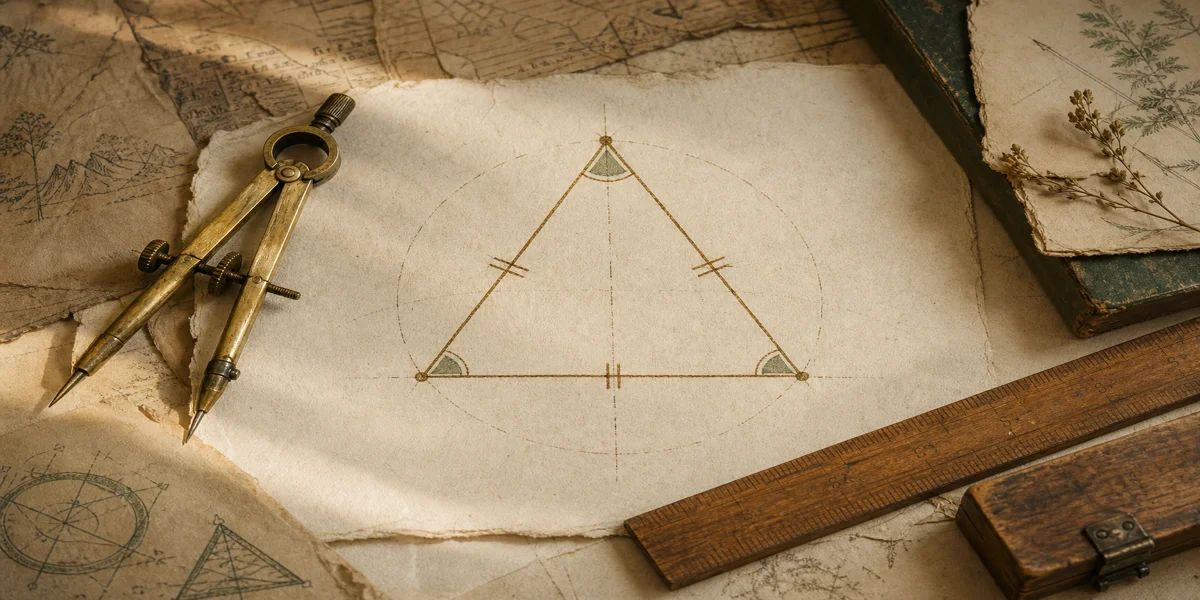

Archive note
Turn story problems into labeled diagrams and perimeter totals you can trust on tests and projects.
Identify a triangle, extract three side facts, add in one unit, and label perimeter.
Formula
After you set up an equation, confirm numeric answers with the Perimeter of a Triangle Calculator.
Word problems hide geometry in everyday language about fences, frames, routes, and borders.
Review how to calculate perimeter if you want the core pencil-and-paper steps before you tackle stories.
Look for three straight edges forming a closed triangle. Curved paths belong to other shapes.
Watch for isosceles clues such as two equal sides on a roof, a symmetric field, or two matching legs on a sign.
Some problems give perimeter and ask for a missing side. Rearrange P = a + b + c with algebra before you panic.
Others describe a route around a triangular park without drawing the shape. Sketch anyway. A blank margin diagram prevents most setup errors.
Pick the form that matches the story before you substitute numbers.
When the text mentions three unequal boundaries, stay with the general sum.
When the text mentions equal sides on a triangular frame, switch to P = 2a + b or P = 3a.
If you are unsure which form fits, compare your sketch with the decision tips in the isosceles triangle perimeter guide before you finalize the sum.
Translate words to a picture, then a picture to arithmetic.
A triangular garden needs border along sides 12 ft, 14 ft, and 9 ft. Perimeter = 35 ft of edging.
An isosceles plot has equal sides 20 m and base 15 m. Perimeter = 55 m.
An equilateral sign has side 3 ft. Perimeter = 9 ft of trim.
A problem states that a triangular lot has perimeter 48 m and sides 16 m and 18 m. The missing side is 48 − 16 − 18 = 14 m after you confirm the story describes a scalene lot.
For more numeric patterns without story text, use perimeter of a triangle examples as a companion set.
Strong word-problem habits: diagram first, units second, perimeter sum last.
When area language appears in the same assignment, pause and read perimeter vs area of a triangle before you choose a formula.
Perimeter vs area of a triangle: formulas, units, cue words, real uses, and common mistakes so you pick the right measurement every time.
Scalene triangle perimeter with unequal sides: P = a + b + c, triangle inequality checks, geometry examples, and practice for tests and projects.
Isosceles triangle perimeter using P = 2a + b: equal-side properties, labeled diagrams, measurement examples, and common homework setups explained.