Archive note
Isosceles Triangle Perimeter (P = 2a + b)
Two equal sides make perimeter a short addition problem once you label the base.
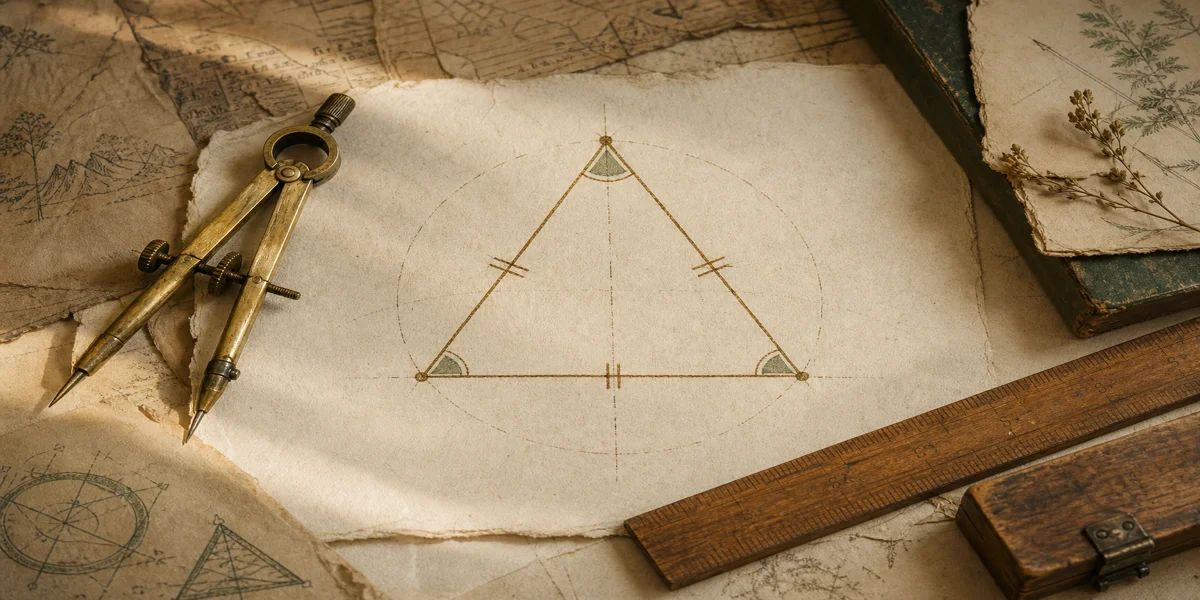

Archive note
Two equal sides make perimeter a short addition problem once you label the base.
P = 2a + b when a is the equal side and b is the base.
Formula
The calculator accepts three side fields: enter the equal length twice and the base once.
Isosceles triangles show up in roofs, symmetric plots, bridge trusses, and many standardized test diagrams where two edges match.
Start from the general rule in what is the perimeter of a triangle if you want the definition before you use shortcuts.
Only two sides match. The third side is the base, and it often sits opposite the angle between the equal sides on diagrams.
Geometric interpretation: symmetry across an altitude from the vertex between the equal sides divides the triangle into mirror halves.
Measurement examples include a triangular plot with two 20 m frontages and a 15 m rear edge, giving P = 55 m.
Common homework problems state two equal sides in words without drawing tick marks, so underline matching lengths before you add.
Example: equal sides 7, base 4 → P = 7 + 7 + 4 = 18.
You may also write P = 2(7) + 4. Both forms are equivalent when labeling is consistent.
If a problem gives perimeter and the base, solve for the equal side with algebra before you move on.
When all three sides differ with no pairs, the triangle is scalene and you should follow the scalene triangle perimeter method instead of forcing P = 2a + b.
Label first, then substitute, then add.
Equal sides 5 in, base 8 in → P = 5 + 5 + 8 = 18 in.
Equal sides 12 ft, base 9 ft → P = 33 ft of fence along a symmetric triangular section.
A roof panel described as isosceles with legs 6 m and base 4 m needs P = 16 m along the outer edges you are quoting.
Label equal sides before you substitute into P = 2a + b.
See more mixed cases in perimeter examples and check results at /#calculator.
Solve triangle perimeter word problems: cue words, sketching tips, fencing and border examples, and how to check answers with a free online calculator.
Perimeter vs area of a triangle: formulas, units, cue words, real uses, and common mistakes so you pick the right measurement every time.
Scalene triangle perimeter with unequal sides: P = a + b + c, triangle inequality checks, geometry examples, and practice for tests and projects.